The Ultimate Setup Guide for Your Razer Raiju V3 Pro
The landscape of professional gaming peripherals has undergone a radical transformation in recent years. As competitive gaming moves further into the mainstream and esports prizes continue to climb, the demand for high-performance hardware has never been higher. Players are no longer satisfied with standard equipment; they require tools that offer a competitive edge through speed, precision, and deep customization. Enter the Razer Raiju V3 Pro, a controller designed specifically for the elite tier of PlayStation 5 and PC gamers who demand nothing less than perfection from their input devices. This guide explores the intricate setup process, technical nuances, and performance capabilities of what many consider the pinnacle of current pro-controller engineering.
The Evolution of the Raiju Series
To understand the Razer Raiju V3 Pro, one must first appreciate its lineage. Razer has spent over a decade refining its controller designs, moving from the chunky aesthetics of the early Xbox 360-era Sabertooth to the sleek, sophisticated silhouettes of the contemporary Raiju line. The V3 Pro represents the culmination of years of feedback from professional fighting game players, first-person shooter specialists, and action-adventure enthusiasts. While previous iterations focused heavily on modularity, the V3 Pro shifts its focus toward structural integrity and the lowest possible latency. It is a device built for the "always-on" gamer who needs a controller that can withstand thousands of hours of high-intensity play without sacrificing the tactile response of its switches or the accuracy of its analog sensors.
Detailed Product Analysis and Performance Review
At the heart of the Razer Raiju V3 Pro is the integration of Razer’s proprietary Mecha-Tactile Action Buttons. Unlike standard membrane buttons found on base controllers, which can feel mushy or inconsistent over time, these switches provide a crisp, clicky response similar to a high-end mechanical gaming keyboard. This tactile feedback is crucial in high-stakes environments where knowing exactly when a button press has registered can be the difference between a successful parry in a soulslike game or a botched combo in a competitive fighter. The actuation distance is significantly reduced, allowing for faster repetitive presses, a feature that translates directly into higher Actions Per Minute (APM) for the player.
The ergonomics of the V3 Pro also deserve significant attention. Razer has opted for a shape that caters to a variety of grip styles, including the traditional palm grip and the more aggressive claw grip used by high-level FPS players. The handles are coated in a high-density rubberized texture that remains grippy even during long sessions where perspiration might otherwise become an issue. One of the standout physical features is the inclusion of the HyperTrigger technology. These are not merely digital switches but adaptive triggers that can be toggled between a full-range pull—perfect for racing games where nuanced acceleration is required—and a hair-trigger mode. In hair-trigger mode, the pull distance is remarkably short, mimicking the click of a mouse, which is the gold standard for competitive sniping and rapid-fire semi-automatic weapon use.
Connectivity is another area where the V3 Pro shines. Utilizing Razer’s HyperSpeed Wireless technology, the controller operates on a 2.4GHz connection through a dedicated USB Type-A dongle. This ensures that the wireless latency is virtually indistinguishable from a wired connection, addressing the primary concern most professional players have with wireless peripherals. For those who still prefer the absolute security of a cable for tournament play, the controller ships with a braided USB-C cable that locks securely into a recessed port, preventing accidental disconnections during vigorous movement.
Technical Specifications and Comparison
When selecting a professional controller, the internal components are just as important as the external buttons. The Razer Raiju V3 Pro utilizes Hall Effect sensors in its analog sticks. Unlike traditional potentiometers that rely on physical contact and are prone to "stick drift" over time, Hall Effect sensors use magnets to track movement. This means there is no physical wear and tear on the tracking mechanism, resulting in a stick that remains accurate for years. Furthermore, the polling rate of 1000Hz ensures that the console or PC receives input updates every single millisecond.
The following table provides a comparison between the Razer Raiju V3 Pro and standard competitive benchmarks to illustrate the leap in hardware quality.
| Feature | Standard Controller | Razer Raiju V3 Pro |
|---|---|---|
| Button Type | Membrane | Mecha-Tactile Switches |
| Analog Stick Sensor | Potentiometer | Hall Effect (Contactless) |
| Trigger Mechanism | Standard Analog | HyperTrigger with Hair-Trigger Mode |
| Connectivity | Standard Bluetooth | HyperSpeed 2.4GHz & Wired |
| Back Paddles/Buttons | None | 4 Integrated Retappable Paddles |
| Audio Support | Basic 3.5mm Jack | 3.5mm with Integrated DAC |
Pros and Cons
While the Razer Raiju V3 Pro is undoubtedly a powerhouse, it is important to weigh its strengths against potential drawbacks for the average consumer. Modern electronics are always a series of trade-offs between features, price, and complexity.
Shop the latest Electronics picks on Amazon.
Browse Now →- Pros:
- Exceptional build quality with premium materials that feel substantial in the hand without being overly heavy.
- Mecha-tactile buttons offer some of the best tactile feedback in the industry, significantly improving timing in rhythmic or high-speed games.
- Hall Effect sensors effectively eliminate the risk of stick drift, providing a long-term solution to a common gaming frustration.
- Extensive customization through the Razer Controller App allows for remapping, sensitivity curves, and vibration adjustment without needing a PC.
- The 8-way microswitch D-pad is a dream for fighting game players, offering precise cardinal and diagonal inputs.
- Cons:
- The premium feature set comes with a significant price tag that may be hard to justify for casual or weekend gamers.
- The larger profile of the controller compared to the standard PlayStation 5 controller might be uncomfortable for those with very small hands.
- Battery life, while respectable at approximately 15-20 hours depending on RGB settings, is lower than some basic controllers due to the high-polling wireless tech.
- Requires a dedicated USB dongle for wireless play on PS5, occupying one of the limited ports on the console.
The Ultimate Setup Process
Achieving the perfect setup with the Razer Raiju V3 Pro involves more than just plugging it in. To truly unlock its potential, a systematic approach to hardware and software configuration is recommended. This setup process ensures that the controller is tuned specifically to the genres you play most.
Step 1: Physical Configuration and Ergonomics
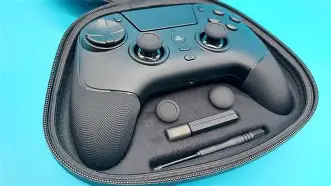
Start by evaluating the physical components. The V3 Pro often comes with interchangeable thumbstick caps. For FPS players, placing a taller, convex cap on the right analog stick provides a longer arc of movement, which allows for finer aiming adjustments and higher sensitivity without losing control. Conversely, a shorter, concave cap on the left stick is ideal for rapid movement and directional changes. Next, adjust the trigger stops. If you are playing a game like Call of Duty, engage the hair-trigger mode immediately to shave milliseconds off your reaction time. If you are switching to a game like Gran Turismo, ensure the triggers are in full-travel mode for better throttle control.
Step 2: Software Integration via the Razer Controller App
Unlike older controllers that required firmware hacks or PC-only tools, the V3 Pro is managed through a streamlined mobile app available on iOS and Android. Connect your controller to your smartphone via Bluetooth (specifically for the app connection) to begin remapping. The four back paddles are the most critical part of this step. In modern gaming, keeping your thumbs on the analog sticks at all times is essential. Map the "face buttons" (Square, Triangle, Circle, X) to the back paddles. This allows you to jump, reload, and swap weapons while simultaneously aiming and moving. You should also take this time to adjust the "Dead Zones." Because the Hall Effect sticks are so precise, you can often set your dead zones to zero or near-zero, resulting in instantaneous movement response.
Step 3: Sensitivity Curves and Haptics
Within the app, you can define the sensitivity curve of the analog sticks. A "Linear" curve is preferred by many professionals for its consistency, but an "Aggressive" curve can help players who want to turn quickly while maintaining precision. The haptic feedback intensity should also be considered. While vibration adds immersion to single-player epics, many competitive players prefer to lower or even disable vibration to prevent the motors from interfering with fine motor control during tense aiming sequences. The V3 Pro allows you to save these configurations into multiple onboard profiles, which can be cycled through using a dedicated button on the controller itself.
Buying Guide: Who is the Razer Raiju V3 Pro For?
Deciding whether to invest in a high-end controller like the Razer Raiju V3 Pro requires an honest assessment of your gaming habits and goals. This is not a "one size fits all" product; it is a specialized tool. Buyers typically fall into three main categories, and what they care about differs significantly.
The Aspiring Esports Competitor
For this user, every millisecond counts. They care about latency, polling rates, and the tactile snap of the buttons. They should prioritize the V3 Pro because of the HyperSpeed Wireless connectivity and the Mecha-Tactile switches. The ability to remap buttons to paddles is not a luxury for them—it is a requirement to stay competitive in lobbies where other players are using similar equipment.
The Long-Term Value Hunter
Interestingly, the V3 Pro appeals to those who are tired of buying new controllers every year due to stick drift. While the initial investment is high, the inclusion of Hall Effect sensors means the controller's primary point of failure—the analog stick—is essentially future-proofed. If you find yourself replacing $70 controllers annually, the V3 Pro eventually pays for itself through its longevity and durable build quality.
Discover deals on Electronics — updated daily.
Browse Now →The Genre Multi-Specialist
If you split your time equally between fighting games, shooters, and racing sims, the V3 Pro’s versatility is its greatest asset. The 8-way D-pad is exceptional for "quarter-circle" inputs in fighters, the hair-triggers excel in shooters, and the analog depth is perfect for simulators. The ability to switch profiles on the fly makes it the "Swiss Army Knife" of high-end input devices.
Real-World Use Cases
To truly appreciate the V3 Pro, one must look at how it performs in specific, high-pressure scenarios. In a fast-paced battle royale, a player using the V3 Pro can slide, jump, and loot without ever taking their thumb off the right stick, thanks to the rear paddles. This "always-aiming" capability provides a massive advantage over standard controller users who must move their thumb to the face buttons, losing aiming control for a fraction of a second.
In highly technical fighting games like Tekken or Street Fighter, the microswitch D-pad provides audible and tactile confirmation of every input. This reduces the "input dropped" frustration common with mushy D-pads on standard controllers. The precision of the 8-way D-pad ensures that unintentional diagonal jumps are minimized, a frequent issue when using less precise hardware.
Even in single-player, narrative-driven experiences, the V3 Pro enhances the experience. The textured grips and ergonomic weight distribution reduce hand fatigue during marathon sessions. The refined haptics can be tuned to provide subtle feedback that enhances immersion without being distracting. It is a premium experience that elevates the tactile connection between the player and the digital world.
Conclusion
The Razer Raiju V3 Pro is more than just a controller; it is a comprehensive upgrade to the gaming experience. By combining cutting-edge sensor technology with mechanical precision and deep software customization, Razer has created a device that addresses nearly every pain point associated with modern console gaming. While the complexity of its features requires a thoughtful setup process, the rewards are immediate: faster reaction times, increased accuracy, and a level of durability that standard hardware simply cannot match. For the gamer who views their hobby as a craft, the V3 Pro is an essential piece of equipment that bridges the gap between raw skill and on-screen performance. Whether you are climbing the ranks in a competitive shooter or looking for the last controller you will ever need to buy, the V3 Pro stands as a testament to the heights of modern peripheral engineering.